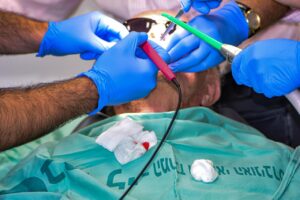
- What is orthognathic surgery?
Orthognathic surgery corrects the position of the upper jaw (maxilla) and lower jaw (mandible) when orthodontics alone is not sufficient. It improves the bite, facial harmony and, in many cases, breathing and sleep quality.
It is indicated for people with:
- Severely altered bite (open bite, crossbite, severe overbite).
- Very protruding or very retruded jaw.
- “Very long” or “very short” face, gummy smile, or facial asymmetries.
- Intense snoring or diagnosis of Obstructive Sleep Apnea.
- Functional and aesthetic benefits
Orthognathic surgery is a functional treatment with a very positive aesthetic impact.
Main benefits:
- Improves chewing, speech, and swallowing.
- Balances the relationship between the maxilla, mandible, chin, and lips.
- Expands the upper airway and can improve snoring and apnea.
- Increases confidence when smiling and self-image confidence.
- Types of orthognathic surgery explained simply
Single-jaw surgery
Only the upper jaw or only the lower jaw is corrected when the other jaw is well positioned. Changes are usually more moderate, but sufficient in many cases.
Double-jaw surgery
Both the upper and lower jaws are operated on in the same procedure to achieve a more complete correction of the bite and facial aesthetics. In cases with a narrow palate and crossbite, the upper jaw can be segmented to widen it.
Surgery First: surgery first, orthodontics after
In selected patients, we can use the “Surgery First” approach, where orthognathic surgery is performed at the beginning of treatment and orthodontics is carried out afterwards. This protocol allows us to correct the relationship between the upper and lower jaws earlier, immediately improve the facial profile and smile, and in many cases shorten the overall treatment duration.
After surgery, orthodontics focuses on precisely adjusting the position of the teeth in their new bone base, maintaining a stable bite and harmonious facial aesthetics. The indication for “Surgery First” is assessed individually, taking into account the type of malocclusion, facial anatomy, and patient expectations.
- The step-by-step process
4.1. Initial study
At the first visit we perform:
- Detailed medical history.
- Facial and intraoral examination, and smile analysis.
- X-rays, 3D scan, and photographs.
With this information, we define the problem and assess whether orthognathic surgery is the best option for you.
4.2. 3D digital planning
Dr. Birbe and our surgical orthodontist design a joint plan:
- They simulate the movements of the upper and lower jaws in 3D.
- They determine the new position of the bones and the ideal fit of the teeth.
- They assess whether a conventional approach or “Surgery First” will be more suitable.
In some cases, surgery is complemented with customized PEEK implants to improve facial support and projection when necessary.
4.3. Surgical orthodontics
It can be organized in two ways:
- Conventional: orthodontics before and after surgery.
- “Surgery First”: surgery first, then orthodontics.
The decision is made on an individual basis according to your malocclusion, facial anatomy, and goals.
4.4. The operation
- Performed in the operating room under general anesthesia.
- Incisionse are made inside the mouth, avoiding visible scars.
- The bones are repositioned and fixed with specific plates and screws.
The duration depends on the complexity and whether one or both jaws are operated on.
4.5. Recovery and follow-up
After surgery:
- The first few days there is swelling and discomfort, controllable with medication.
- A liquid or soft diet is recommended, gradually expanding it.
- Orthodontics continues to fine-tune the fit of the teeth.
The final goal is a stable bite, more comfortable breathing, and a harmonious face.
- Recovery: approximate timelines
Times may vary, but as a reference:
- 1st week: maximum swelling, need for rest.
- 2nd–3rd week: clear reduction in swelling, gradual return to light activities.
- 1st–3rd month: most patients resume their normal routine, avoiding impacts to the face.
Complete bone consolidation takes several months, but changes in aesthetics and function are noticeable from the first weeks.
- Risks and safety
Like any major surgery, orthognathic surgery carries risks:
- Swelling and bruising.
- Postoperative discomfort or pain.
- Temporary sensory alterations (lip, chin).
- Rare complications associated with anesthesia or healing.
The team’s experience, digital planning, and careful follow-up help minimize these risks and manage any issues if they arise.
- Frequently asked questions
Will my face change a lot?
We seek a natural and proportionate result, adapted to your features. It’s not about “changing your face,” but harmonizing it.
Is orthodontics always necessary?
In most cases, yes, because it allows the teeth to fit properly in their new position.
How long will I be off work?
Many people need between 2 and 4 weeks off, depending on the type of work and individual recovery.
Are the results stable?
With good planning, precise execution, and an adequate retention phase, the results are stable in the long term.
- Why choose Clínica Birbe
At Clínica Birbe we combine:
- The leadership of Dr. Joan Birbe, ABOMS certified maxillofacial surgeon.
- Our own team of surgical orthodontics and oral rehabilitation.
- 3D digital planning and mastery of advanced techniques, such as customized PEEK implants when needed.
- Care for national and international patients in Spanish, Catalan, English, and French.
- Your first visit
At the first orthognathic surgery consultation:
- We will analyze your case personally.
- We will clearly explain your treatment options.
- We will provide you with a fixed quote and financing options.