
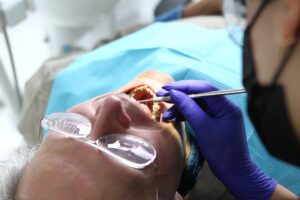
Open Bite in Barcelona
What Is an Open Bite?
This leads to severe impairments in chewing, temporomandibular joint (TMJ) function, and speech. It is common to be unable to pronounce certain syllables correctly, especially those that require placing the tongue behind the upper front teeth. It is also common to be unable to cut food with the front teeth (incisal function), which makes it difficult, for example, to eat a sandwich.
Types of Open Bite
- A skeletal open bite is treated with orthognathic surgery and orthodontics.
- An open bite is treated with orthodontics—that is, by placing braces and moving the teeth in such a way as to correct the bite. It is common to observe a tongue-thrust habit, in which the tip of the tongue is placed between the teeth when swallowing, contributing to an open bite. We will also correct this tongue habit using orthodontic appliances and speech therapy.
We often see patients with skeletal open bites who have been treated with orthodontics alone, and who, after some time, experience a relapse of the open bite. That is why a skeletal open bite must be treated with surgery and orthodontics; otherwise, it is not stable.
Surgical Steps
Orthognathic surgery is the most common treatment for skeletal open bite. In cases where we only want to correct an open bite because there are no other associated abnormalities, treatment can be limited to monomaxillary orthognathic surgery—either posterior maxillary impaction or counterclockwise rotation of the mandible. Depending on the cause and your facial features, we’ll determine which one is best for you.
If there are abnormalities associated with an open bite, such as a short or long jaw (prognathism), a long face, or asymmetries, then the correction will involve bimaxillary orthognathic surgery. Orthognathic surgery is often combined with a mentoplasty.
Treatment Process
The treatment of an open bite follows a structured process, in which the first key decision is to determine whether the cause is dental, skeletal, or mixed.
1. Initial visit and differential diagnosis. Dr. Birbe performs a complete facial and oral examination to identify the type of open bite. Skeletal signs (long face, lack of contact between the incisors, altered occlusal plane) and dental signs (tongue-thrusting habit, previous thumb-sucking, resting position of the tongue) are assessed.
2. Additional studies. A CBCT (3D dental CT scan), a cephalometric radiograph, clinical photographs, and an intraoral scan are performed. These studies make it possible to accurately measure the degree of opening, the inclination of the occlusal plane, and the vertical skeletal pattern.
3. Assessment of tongue habits. When atypical swallowing or tongue interposition is detected, we coordinate with a speech-language pathologist for rehabilitation, which is essential for preventing recurrence in both dental and skeletal cases.
4. Virtual surgical planning (if applicable). In skeletal open bites, the movement is simulated in 3D: posterior impaction of the maxilla, counterclockwise rotation of the mandible, advancement, and/or associated mentoplasty. The patient can view the expected result before making a decision.
5. Pre-surgical orthodontics. In cases requiring surgery, the dental arches are aligned using braces or aligners for 6–18 months so that they fit properly after surgery.
6. Orthognathic surgery. The procedure is performed in a hospital operating room under general anesthesia and requires a 1- to 2-night hospital stay. Monomaxillary when only an open bite needs to be corrected; bimaxillary if there is prognathism, a long face, or associated asymmetries.
7. Post-surgical orthodontics and tongue re-education. The occlusal adjustment is completed, and the new tongue habit is established—a key factor in the stability of the result.
8. Inspections and maintenance using retainers. Retainers are used indefinitely for this type of malocclusion.
Recovery time
Recovery from open-bite surgery is similar to that of other orthognathic surgeries, with the exception that functional rehabilitation (chewing, speech, and swallowing) plays a particularly important role.
| Phase | Estimated timeframe | What to Expect |
|---|---|---|
| Hospital Admission | 1–2 nights | Pain management, facial ice packs, cold liquid diet |
| First Week | Days 1–7 | Swelling peaks between the 3rd and 5th day; liquid diet; rest at home; sick leave |
| Weeks 2 and 3 | Days 8–21 | Significant reduction in swelling, soft, pureed diet, start of mouth-opening exercises |
| 1st month | 30 days | Return to work in most cases; a soft, non-pureed diet |
| 2–3 months | 60–90 days | Gradual return to a normal diet, return to light exercise, start or continue speech therapy |
| 6 months | 180 days | Advanced bone consolidation, restored incisal function (ability to cut food with the incisors), unrestricted sports participation |
| 12 months | 1 year | Final occlusal, aesthetic, and functional outcome |
The restoration of incisal function —being able to cut into a sandwich with the front teeth again—is one of the most significant milestones for patients with an open bite, and it is usually achieved naturally by the 2nd–3rd month. Concurrent speech therapy with a speech-language pathologist is what consolidates the results and prevents relapse.
Duration of treatment
The overall duration depends primarily on the complexity of the case and whether orthodontic treatment plus surgery is required or just orthodontic treatment.
|
|---|
At Clínica Birbe, we provide a realistic timeline during the first visit, outlining the key milestones of the process. An open bite is one of the malocclusions with the highest risk of relapse if the correct component (skeletal or lingual) is not treated; therefore, the treatment plan is designed with long-term stability in mind, not just to close the bite in the short term.
Frequently Asked Questions About Open Bite
How do I know if my open bite is dental or skeletal?
That’s the first question we need to answer, because the treatment is completely different. An open bite occurs when the teeth are misaligned (often due to a habit of pushing the tongue between them while swallowing), but the maxilla and mandible are properly positioned: it is treated with orthodontics and, when a tongue habit is present, with speech therapy. A skeletal open bite, on the other hand, is a problem with the facial bones: the upper jaw has grown too far downward, the lower jaw has an unfavorable rotation, or both. In this case, moving only the teeth with braces can temporarily close the bite, but relapse often occurs because the bone structure continues to push it open. At Clínica Birbe in Barcelona, we perform a differential diagnosis using a clinical examination, cephalometric teleradiography, and CBCT before recommending any treatment. Knowing the correct type from the start is the best way to prevent recurrence.
Why is there such a high rate of relapse in patients treated with orthodontics alone?
Because in many cases of skeletal open bites, orthodontic treatment can temporarily close the bite, but the bone structure that caused it remains. When the braces are removed, the weight of the tongue, the facial muscles themselves, and the pattern of vertical growth cause the bite to open up again within a few months or a few years. Added to this, in many cases, is an untreated tongue-thrust habit: the patient continues to push the tongue between the teeth when swallowing between 1,000 and 2,000 times a day, and that overcomes any orthodontic retention. That is why, when the diagnosis confirms a skeletal component, it is not a matter of “longer” or “stronger” orthodontic treatment: it is orthodontic treatment combined with orthognathic surgery and, if necessary, speech therapy. It is the only way to achieve a result that remains stable over time.
Can an open bite be corrected surgically without having to treat both dental arches?
Yes, in select cases. When the problem is limited to an open bite and there are no other abnormalities—no prognathism, long face, asymmetries, or associated aesthetic issues—unimaxillary orthognathic surgery may be considered. The two common techniques are posterior maxillary impaction (raising the back of the upper jaw so that the mandible rotates and closes the bite) or counterclockwise rotation of the mandible. These procedures are less extensive than bimaxillary surgery, with a somewhat more comfortable postoperative recovery, and are very effective when performed for the right indication. If, on the other hand, there are associated abnormalities (short or long jaw, long face, asymmetries), bimaxillary advancement typically yields better functional and aesthetic results. Dr. Birbe uses 3D planning before surgery to determine which technique is best suited for each case.
What role does speech therapy play in treatment? Is it really necessary?
In cases of open bites with atypical swallowing or tongue interposition, speech therapy is not an optional add-on: it is part of the treatment. The tongue is one of the strongest muscles in the body relative to its size, and if it continues to push forward between the front teeth when swallowing and speaking, it will eventually undo any orthodontic or surgical results. That is why, at Clínica Birbe, we work with a speech-language pathologist starting from the diagnostic phase to correct the resting position of the tongue, the swallowing pattern, and, when necessary, the articulation of the affected syllables. In adult patients, it requires persistence (it’s usually a 6- to 12-month process), but that’s what turns a good short-term result into a stable result 10 or 20 years down the road. Performing orthodontic treatment or placing braces without correcting a tongue habit—when one exists—is a recipe for relapse.
Does Social Security in Catalonia cover open-bite surgery?
Orthognathic surgery to correct severe malocclusions, including skeletal open bite with functional repercussions (mastication, speech, TMJ), is covered under the National Health System and CatSalut in Catalonia when there is a documented medical indication. In practice, wait times are long, prior orthodontic treatment is not usually covered (which accounts for a significant portion of the actual cost of treatment), and very few public facilities perform orthognathic surgery frequently enough to maintain experienced teams. In the private sector, some mutual insurance companies partially cover the surgical procedure, depending on the policy, but rarely cover the orthodontic phase. At Clínica Birbe in Barcelona, we help each patient review their insurance policy, prepare the necessary reports, and understand exactly what each treatment option covers before making a decision. And we offer a fixed-price quote and financing options so that the financial aspects are transparent from day one.
Dr. Joan Birbe: ABOMS certified specialist
Dr. Joan Birbe is the only oral and maxillofacial surgeon in Spain certified by the American Board of Oral and Maxillofacial Surgery (ABOMS), the leading international authority in oral and maxillofacial surgery. This rigorous, renewable certification ensures that his training, clinical experience, and surgical criteria meet U.S. standards, which are considered the most rigorous in the world for this specialty.
In the treatment of open bite, that difference is evident in what matters most: the clinical decision. Accurately distinguishing between a skeletal open bite and a dental open bite, correctly identifying posterior maxillary impaction versus counterclockwise mandibular rotation, or knowing when to combine the procedure with mentoplasty—these are the factors that distinguish a stable, long-term outcome from a relapse two years later.
With more than 20 years of experience treating complex orthognathic surgery cases in Barcelona, Dr. Birbe combines virtual surgical planning, close coordination with the orthodontist, and a comprehensive aesthetic-functional approach: correcting an open bite while maintaining the balance of the lower third of the face, the profile, and the smile.
When a patient with an open bite comes to Clínica Birbe, they don’t just receive a single opinion: they receive an ABOMS diagnosis and a comprehensive treatment plan.
Why Choose Clínica Birbe for Surgery?
An open bite is one of the most challenging malocclusions to treat because its diagnosis—determining whether it is dental, skeletal, or mixed—completely determines the long-term outcome. An error in judgment during that initial assessment is the most common cause of relapse that we see in our practice: patients who have been treated for years with orthodontics alone and who, months after their braces are removed, experience a relapse of their bite.
At Clínica Birbe in Barcelona, we treat open bites with a multidisciplinary team in which the oral and maxillofacial surgeon, the orthodontist, and—when necessary—the speech-language pathologist work together from day one on the same treatment plan. This prevents decisions from being made in isolation and makes it possible to determine in advance whether the case requires orthognathic surgery, orthodontic treatment with tongue re-education, or a combination of both.
We use 3D virtual planning, an intraoral scanner, and surgical simulation before entering the operating room, so that the patient knows exactly what adjustments will be made to the maxilla, mandible, and chin before making any decisions. And, above all, we provide a fixed, personalized quote after the initial assessment—with no surprises later on.
Our commitment is clear: if your open bite is skeletal, we’ll tell you; if it’s dental and can be corrected without surgery, we’ll tell you that, too. Diagnostic accuracy is the most effective way to prevent relapses.
Testimonials
We are collecting verified testimonials from our patients
We want this section to feature real and diverse experiences from patients treated at Clínica Birbe. If you have been a patient and would like to share your experience, please write to us: your feedback helps us improve and provides guidance to other patients who are considering this treatment.
All testimonials are always published with the patient’s express consent and in accordance with the GDPR.
Latest News

Best maxillofacial surgeon in Barcelona
Choosing the best maxillofacial surgeon in Barcelona is essential for those who need specialized treatment in oral, maxillofacial, or reconstructive surgery. The decision is not
Dr. Birbe is internationally certified in oral and maxillofacial surgery by ABOMS.
Dr. Birbe holds an international certification in oral and maxillofacial surgery granted by ABOMS, representing a professional profile with advanced training and international standards of
Clinics that perform orthognathic surgery in Barcelona
Clinics that perform orthognathic surgery in Barcelona are specialized centers for the diagnosis and treatment of jaw alterations that affect bite, chewing function, and facial
Best rhinoplasty specialists in Barcelona
The best rhinoplasty specialists in Barcelona are professionals who perform aesthetic and functional nasal surgery with the aim of improving breathing and facial harmony. It

WhatClinic Patient Service Award for Clínica Birbe
Birbe, Aesthetic Medicine Clinic in Barcelona, wins the WhatClinic Patient Service Award. This is an international recognition that highlights clinics with the best ratings for
3D Planning in Orthognathic Surgery: What It Is and Why It Improves Aesthetic and Functional Results
Three-dimensional (3D) planning has changed the way orthognathic surgery is approached. Today, it is possible to study each bone structure in detail, simulate jaw movements
We help you to perform the intervention you need
After a rigorous evaluation, we offer you a personalized and closed budget with all the necessary forms of payment and financing, so that you can carry it out.
Our recommendations
Contact
with us
Contact us during our business hours:
- Monday, Thursday and Friday from 8:00 a.m. to 4:00 p.m.
- Tuesday and Wednesday from 8:00h to 19:00h.
- Phone: +34 93 212 47 37
Outside our working hours you can send us a WhatsApp or a form and we will get back to you the next business day. Being located in Barcelona, we receive patients from all over the national and international territory.
During your first consultation we will provide you with:
Personal diagnosis by oral and facial examination.
Closed budget with different financing financing possibilities.